Related to: Applications
개요
1 Stage Detector는 ‘Class imbalance’라는 고질적인 문제를 갖고 있었습니다.
- Class imbalance
- Grid로 나눠서 Cell 마다 모두 Bbox를 추정하게 함
- Positive Sample(Object area) < Negative Sample(BG Area)
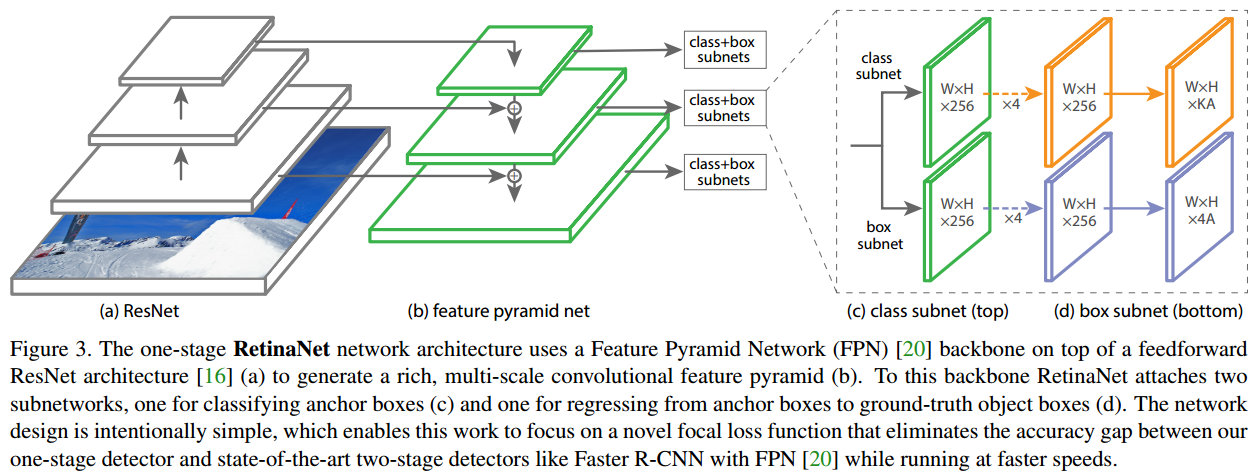
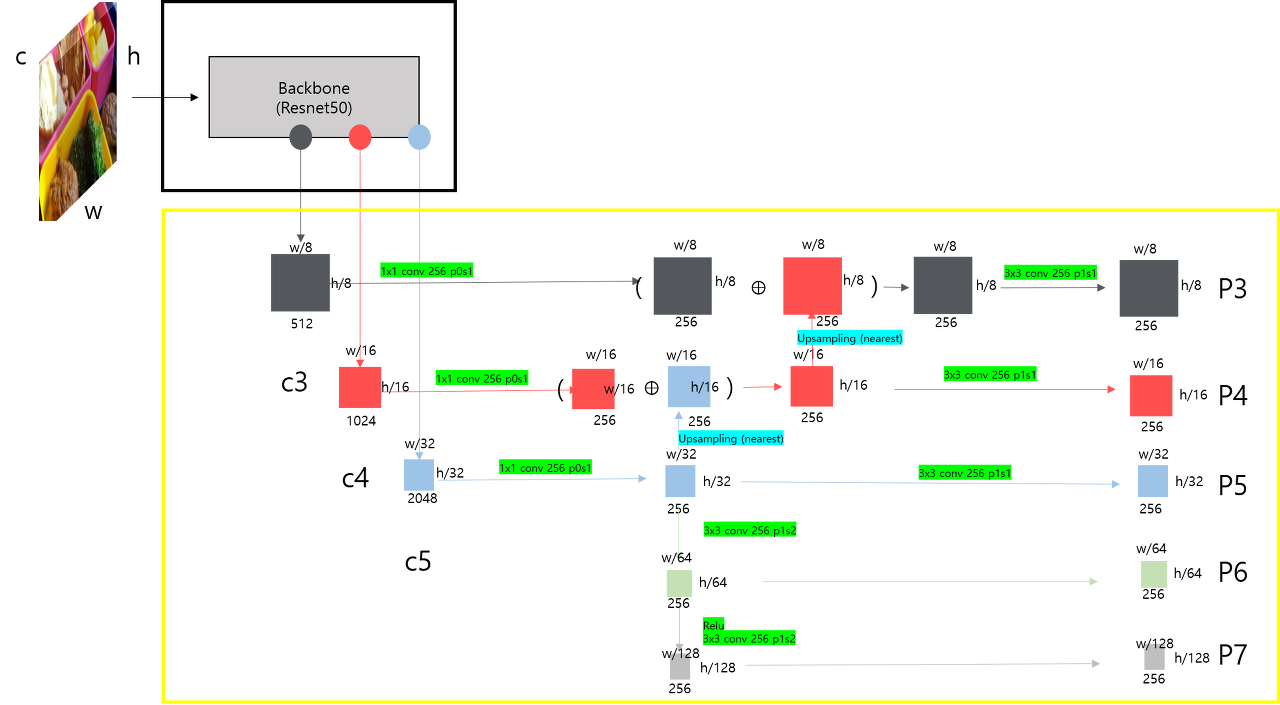
RetinaNet은 One-stage Detector입니다. Class imbalance 문제를 해결하기 위해 Focal Loss를 제안했으며 이를 통해 낮은 확률의 클래스에 대한 학습 성능을 향상시켰고, ResNet 구조의 FPN(Feature Pyramid Network) Network를 Backbone으로 사용하여 Two-stage Detector인 Faster R-CNN의 정확도를 능가했습니다.
핵심 개념
One-Stage Detector인 이유
class+box subnet을 보면 class를 예측하는 network와 box를 예측하는 network가 나누어져 있습니다.
이 구조를 보면 two stage detector가 아닌가 생각 할 수도 있지만, 자세히 살펴보면 class subnet은 box subnet의 결과를 전혀 사용하지 않고 독립적으로 anchor 별 class 예측을 한다는 것을 알 수 있습니다.
그러므로 RetinaNet은 One-Stage Detector입니다.
Focal Loss
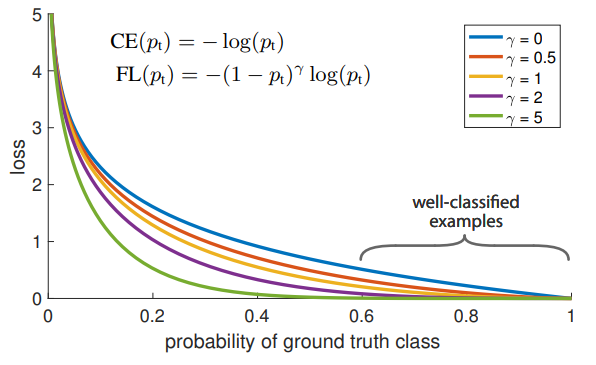
Focal loss는 one-stage object detector의 극단적인 class imbalance 문제를 해결하기 위해 design 된 loss function입니다.
저자는 실험적으로 alpha=0.25, gamma = 2가 가장 성능이 좋았다고 합니다.
관련 개념
- Two-stage detector vs One-stage detector — RetinaNet이 One-stage임을 이해하는 배경 지식
- FPN(Feature Pyramid Network) — RetinaNet의 Backbone으로 사용되는 구조
- ResNet — FPN의 기반이 되는 Backbone 네트워크
- Yolo v1(You Only Look Once) — 대표적인 다른 One-stage Detector
- SSD(Single Shot Multibox Detector) — RetinaNet과 비교되는 One-stage Detector
- Loss Function for task — Focal Loss가 속하는 loss function 범주
참조
Focal Loss for Dense Object Detection
The highest accuracy object detectors to date are based on a two-stage approach popularized by R-CNN, where a classifier is applied to a sparse set of candidate object locations. https://arxiv.org/abs/1708.02002